This is sad 😢
Uncategorized
41
Posts
22
Posters
0
Views
-
#Mozilla has lost their ground and is now in a free fall into a sinkhole. I doubt they'll ever get out if this again unless they do a 180-turn within the coming days. Mozilla has lost a lot of trust and credibility over the last couple of years. This accelerates that distrust even more.
https://blog.mozilla.org/en/firefox/update-on-terms-of-use/
It looks promising, until you hit the last paragraph (my highlight)
In order to make Firefox commercially viable, there are a number of places where we collect and share some data with our partners, including our optional ads on New Tab and providing sponsored suggestions in the search bar. We set all of this out in our privacy notice. Whenever we share data with our partners, we put a lot of work into making sure that the data that we share is stripped of potentially identifying information, or shared only in the aggregate, or is put through our privacy preserving technologies (like OHTTP).
In my book, that's indirectly selling data.
Goodbye, #Firefox.
Update (2026-02-26): So this change happened exactly 1 year ago. I saw the date and missed the year. And since Mozilla is still doing the privacy whitewashing, there is no reason to trust Mozilla more today than a year ago. Leaving Firefox is unavoidable. The current Mozilla leadership does not deserver much trust from the community.
@dazo Unfortunately, there is no alternative (only worse - Google). We are waiting and hoping for the #ladybirdbrowser
-
@EdCates @dazo @graves501 @theorangetheme not everyone has ensuring a balance in html-engines as one of their top priorities when choosing their browser.
Not sure why this is giving you headaches.
Especially in today's world where there only are 2 usable browser engines and both are connected and depending on companies that are not exactly trustworthy.
Firefox and chromium might be open source, but let's be honest, there isn't a community that could maintain them independent from Mozilla and Google.
Would I prefer if there was a Opera 12/Vivaldi like browser with a third engine? Sure! For all the issues it caused for me I loved presto and I hope one day someone builds something of that type around servo.
But also keep in mind: Mozilla killed Gecko as a standalone product, there is a reason why we only have lightly patched Firefox variants and not a single truly different web browser using Gecko nowadays.@mxk @EdCates @graves501 @theorangetheme
What "gives me headaches" when a browser render engine gets a monopoly, we easily end up with the complete chaos we had with Internet Explorer roughly 20 years ago. Web sites had to account for IE3, IE4-5 and IE 6 version plus the "minority others". A web page would end up behaving completely different across all these aspects. The Opera browser was at that time one of the engines which was close to most compliant to the web standards.
Microsoft extended IE without caring about standards and since it was the dominating browser at that time, they didn't care much about the standards. They had their own standards. But they also didn't care about compliance between their own versions even.
Web developers at that time focused on getting the IE experience as best as they could and then came the minority browsers.
This can easily happen again if Chromium ends up without real competition. Then Google can do whatever they want with Chrome, drop caring about standards since it "owns" the browser scope. And by doing that, websites starts to adopt to make sure web sites renders best on Chrome, resulting in people being locked in with Chrome. And somewhere along this path, Google can ditch the open source Chromium - just as they try to squeeze out the third-party Android apps these days.
By not having a real competition in any market space, we users/consumers ends up as the losing part sooner than later.
-
@dazo Why look at a change from Feb 25, 2025 (exactly a year ago)? Have you looked at the current page? https://www.mozilla.org/en-US/privacy/faq/
@flod Hah, very good point! I'm still stuck in 2025 - and this was exactly one year ago when I posted that.
But I'm not calmed at all by the latest privacy faq.
We strive to only collect the data we need to make the best products
They say clearly they collect data, but not what they use it for in practice. «[...] make the best products» can mean sell data to get funding for development.
We work to put people in control of their data and online experiences.
Really? Just after lots of users push for a change, like the by default enabled AI engine. It took them a few releases to add the needed toggles. And do we still trust there are no more switches needed to be toggled via about:config - or can't be disabled at all? If Mozilla would have had credibility, yes, then we could trust this more. But they've done so much user and privacy hostile moves over the last few years their trust and credibility is vanishing fast.
We adhere to the “no surprises” principle, meaning we work hard to ensure people’s understanding of Firefox matches reality.
Just like enabling AI by default .... taking lots of users by surprise when they realised that Firefox suddenly became a huge resource hog. I wonder what kind of reality Mozilla lives in. It sure is not aligned with what most of the privacy aware Firefox users live in.
We don’t know your age, gender, precise location, or other information Big Tech collects and profits from.
While that sounds good, they say earlier that they do collect information. And data being made anonymous or being pseudo-anonymous are still not good enough. There are plenty of stories where it's been possible to reveal the identity of persons based on anonymous data. Like having GPS tracking data for thousands of users and correlating that information with time stamps. Then patterns appears and you can start identifying where people live and work easily.
But ...
Mozilla does collect a limited set of data by default from Firefox that helps us to understand how people use the browser.
I don't think more is needed to be said.
This whole faq is just trying to make Mozilla look nice. Google has also had similar claims back in the days, when they had the "Don't be evil" slogan. But it turns out that wasn't enough.
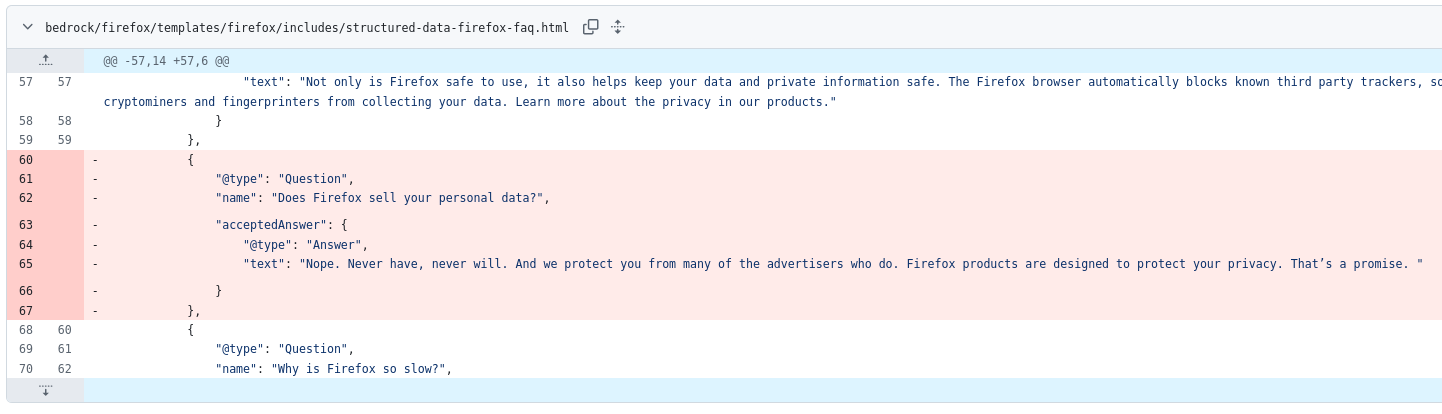
The best way to preserve users privacy is to start by not collecting any data by default. In Firefox, any data collection need to be disabled explicitly by default. And they still do not dare to say explicitly "we don't benefit financially from your data" (since "sell" was a too broad expression for them).
The fact is, we don't really know what or how Mozilla really uses the data they collect. All we know is that they do collect data, that it is being used and that they have removed any statements about "selling" data completely.
It's just to connect these dots. There is nothing I've read lately which says there are no connection between them.
-
@mxk @EdCates @graves501 @theorangetheme
What "gives me headaches" when a browser render engine gets a monopoly, we easily end up with the complete chaos we had with Internet Explorer roughly 20 years ago. Web sites had to account for IE3, IE4-5 and IE 6 version plus the "minority others". A web page would end up behaving completely different across all these aspects. The Opera browser was at that time one of the engines which was close to most compliant to the web standards.
Microsoft extended IE without caring about standards and since it was the dominating browser at that time, they didn't care much about the standards. They had their own standards. But they also didn't care about compliance between their own versions even.
Web developers at that time focused on getting the IE experience as best as they could and then came the minority browsers.
This can easily happen again if Chromium ends up without real competition. Then Google can do whatever they want with Chrome, drop caring about standards since it "owns" the browser scope. And by doing that, websites starts to adopt to make sure web sites renders best on Chrome, resulting in people being locked in with Chrome. And somewhere along this path, Google can ditch the open source Chromium - just as they try to squeeze out the third-party Android apps these days.
By not having a real competition in any market space, we users/consumers ends up as the losing part sooner than later.
@dazo all true.
But not everyone bases their choice of the browser solely on engine politics.
The feature set of Firefox and Chrome is similarly enough that one could argue for that, but Vivaldi is different.
Any other browser means I would need to give up on my mail client, calendar and so on in my browser. Also I use the sync between desktop and mobile, meaning any browser that's not available for both is out of the picture for me instantly.
If there will be a servo based browser that can do what ever Vivaldi does and that also exists for Android in a usable form, I would be happy to switch. -
@dazo all true.
But not everyone bases their choice of the browser solely on engine politics.
The feature set of Firefox and Chrome is similarly enough that one could argue for that, but Vivaldi is different.
Any other browser means I would need to give up on my mail client, calendar and so on in my browser. Also I use the sync between desktop and mobile, meaning any browser that's not available for both is out of the picture for me instantly.
If there will be a servo based browser that can do what ever Vivaldi does and that also exists for Android in a usable form, I would be happy to switch.@mxk Well, what to say ... Ignorance is bliss, perhaps?
The same arguments can be used about any type of politics. If you don't care about the details of the politics, you have not much to complain about when reality hits you.
Your arguments are common. And most users just want "something that works". Everyone gets that. Everyone, even I, want that. But if nobody fights for freedom, the freedom will eventually be taken away from everyone - also those who didn't care to join the fight. That's the reality.
But there must be room for some pragmatism. Sometimes you need to use what works while fighting the good cause. But that is not the same as ignoring there is something to fight for.
-
@mxk Well, what to say ... Ignorance is bliss, perhaps?
The same arguments can be used about any type of politics. If you don't care about the details of the politics, you have not much to complain about when reality hits you.
Your arguments are common. And most users just want "something that works". Everyone gets that. Everyone, even I, want that. But if nobody fights for freedom, the freedom will eventually be taken away from everyone - also those who didn't care to join the fight. That's the reality.
But there must be room for some pragmatism. Sometimes you need to use what works while fighting the good cause. But that is not the same as ignoring there is something to fight for.
@dazo it's just naive to believe that individual decisions could solve regulation issues.
And asking people to make major sacrifices to their workflows just for political reasons is an incredibly privileged position. -
@dazo it's just naive to believe that individual decisions could solve regulation issues.
And asking people to make major sacrifices to their workflows just for political reasons is an incredibly privileged position.@mxk It's naive when you stand alone. Just as it is naive to call a single waterdrop a sea.
When individuals unite, it becomes a movement which can cause a change.
How else do you think Linux became the dominant server OS on the Internet? It all started with with a single individual saying:
I'm doing a (free) operating system (just a hobby, won't be big and professional like gnu) for 386(486) AT clones.
Now it is available for lots of platforms and used "everywhere". There are tons of such examples.
People must unite. And even "going with the flow" of what "everyone else uses" is exactly the same thing. You've just joined a different movement.
If nobody does nothing, nothing will ever change.
-
@mxk It's naive when you stand alone. Just as it is naive to call a single waterdrop a sea.
When individuals unite, it becomes a movement which can cause a change.
How else do you think Linux became the dominant server OS on the Internet? It all started with with a single individual saying:
I'm doing a (free) operating system (just a hobby, won't be big and professional like gnu) for 386(486) AT clones.
Now it is available for lots of platforms and used "everywhere". There are tons of such examples.
People must unite. And even "going with the flow" of what "everyone else uses" is exactly the same thing. You've just joined a different movement.
If nobody does nothing, nothing will ever change.
@dazo Linux got adoption due to its features, not because of politics.
Some people might work on it out of idealism, but wide adoption and financing come from Linux actually being a useful project.
-
@dazo Linux got adoption due to its features, not because of politics.
Some people might work on it out of idealism, but wide adoption and financing come from Linux actually being a useful project.
Linux got adoption due to its features, not because of politics.
Not quite so simple. You skip why Linux was created in the beginning. It was because there was no affordable Unix alternatives available to students.
All the features we take for granted in Linux today was lacking in the beginning. It was a pretty limited OS in the beginning, only supporting a very limited set of hardware.
But Linux got adoption because it was a community wanting to builds something better, which happened to happen in the open. And it gained features through open collaboration. It was not a commercial drive itself which gave Linux the adoption.
What gave adoption was the freedom it delivered. You can call freedom a feature in this context. And others have tried to stop Linux from gaining success over the years; from Microsoft calling it a cancer, to SCO suing it for copyright issues.
The reason more and more companies decided to bet on Linux, support it in various ways, the reason some companies tried to fight Linux ... they are all based in (corporate/business) politics.
What Mozilla is doing is contrary to this. And Firefox is the immediate collateral damage, which makes the whole browser scope more difficult unless a sustainable alternative surfaces. The Chrome/Chromium dominance today is therefore a considerable threat for an open, free and sustainable browser experience.
We have already been down this path before, with Internet Explorer. We don't need to repeat these mistakes. In that sense, the Chrome browser "saved us" back then. Now Chrome/Chromium has become the new threat.
-
Linux got adoption due to its features, not because of politics.
Not quite so simple. You skip why Linux was created in the beginning. It was because there was no affordable Unix alternatives available to students.
All the features we take for granted in Linux today was lacking in the beginning. It was a pretty limited OS in the beginning, only supporting a very limited set of hardware.
But Linux got adoption because it was a community wanting to builds something better, which happened to happen in the open. And it gained features through open collaboration. It was not a commercial drive itself which gave Linux the adoption.
What gave adoption was the freedom it delivered. You can call freedom a feature in this context. And others have tried to stop Linux from gaining success over the years; from Microsoft calling it a cancer, to SCO suing it for copyright issues.
The reason more and more companies decided to bet on Linux, support it in various ways, the reason some companies tried to fight Linux ... they are all based in (corporate/business) politics.
What Mozilla is doing is contrary to this. And Firefox is the immediate collateral damage, which makes the whole browser scope more difficult unless a sustainable alternative surfaces. The Chrome/Chromium dominance today is therefore a considerable threat for an open, free and sustainable browser experience.
We have already been down this path before, with Internet Explorer. We don't need to repeat these mistakes. In that sense, the Chrome browser "saved us" back then. Now Chrome/Chromium has become the new threat.
@dazo even if I would buy into your position:
Which browser would be the freedom haven that people form a community around and enjoy the freedom.
Firefox isn't a community project in any serious fashion, nor is chrome.
If you look for that type of dynamic, servo is the best bet we currently have. And it's just not there yet, to be usable as your daily driver.
-
this is from last year
-
@dazo It's like when Google took "don't be evil" out of their motto. They're self-aware, at least, I guess, maybe that's worth something?
-
@dazo This is like when the warrant canary doesn't squawk.
-
@EdCates @dazo @graves501 @theorangetheme not everyone has ensuring a balance in html-engines as one of their top priorities when choosing their browser.
Not sure why this is giving you headaches.
Especially in today's world where there only are 2 usable browser engines and both are connected and depending on companies that are not exactly trustworthy.
Firefox and chromium might be open source, but let's be honest, there isn't a community that could maintain them independent from Mozilla and Google.
Would I prefer if there was a Opera 12/Vivaldi like browser with a third engine? Sure! For all the issues it caused for me I loved presto and I hope one day someone builds something of that type around servo.
But also keep in mind: Mozilla killed Gecko as a standalone product, there is a reason why we only have lightly patched Firefox variants and not a single truly different web browser using Gecko nowadays.@EdCates @mxk @theorangetheme @dazo @graves501 oh but
lynx,links2, www-wo-miru, @dillo and Arachne are also very usable browsers, all with their own rendering engines with respective upsides and downsides. I know I switch between them depending on what site renders better where. -
@dazo all true.
But not everyone bases their choice of the browser solely on engine politics.
The feature set of Firefox and Chrome is similarly enough that one could argue for that, but Vivaldi is different.
Any other browser means I would need to give up on my mail client, calendar and so on in my browser. Also I use the sync between desktop and mobile, meaning any browser that's not available for both is out of the picture for me instantly.
If there will be a servo based browser that can do what ever Vivaldi does and that also exists for Android in a usable form, I would be happy to switch. -
@EdCates @dazo @graves501 @theorangetheme not everyone has ensuring a balance in html-engines as one of their top priorities when choosing their browser.
Not sure why this is giving you headaches.
Especially in today's world where there only are 2 usable browser engines and both are connected and depending on companies that are not exactly trustworthy.
Firefox and chromium might be open source, but let's be honest, there isn't a community that could maintain them independent from Mozilla and Google.
Would I prefer if there was a Opera 12/Vivaldi like browser with a third engine? Sure! For all the issues it caused for me I loved presto and I hope one day someone builds something of that type around servo.
But also keep in mind: Mozilla killed Gecko as a standalone product, there is a reason why we only have lightly patched Firefox variants and not a single truly different web browser using Gecko nowadays.@mxk @dazo @graves501 @theorangetheme
What gives me a headache is contributing to turning the WWW into Google's private playground while carrying on like they're the scrappy, unsung rebel's choice.
Nah. It's just Chromium in a nicer suit.
-
#Mozilla has lost their ground and is now in a free fall into a sinkhole. I doubt they'll ever get out if this again unless they do a 180-turn within the coming days. Mozilla has lost a lot of trust and credibility over the last couple of years. This accelerates that distrust even more.
https://blog.mozilla.org/en/firefox/update-on-terms-of-use/
It looks promising, until you hit the last paragraph (my highlight)
In order to make Firefox commercially viable, there are a number of places where we collect and share some data with our partners, including our optional ads on New Tab and providing sponsored suggestions in the search bar. We set all of this out in our privacy notice. Whenever we share data with our partners, we put a lot of work into making sure that the data that we share is stripped of potentially identifying information, or shared only in the aggregate, or is put through our privacy preserving technologies (like OHTTP).
In my book, that's indirectly selling data.
Goodbye, #Firefox.
Update (2026-02-26): So this change happened exactly 1 year ago. I saw the date and missed the year. And since Mozilla is still doing the privacy whitewashing, there is no reason to trust Mozilla more today than a year ago. Leaving Firefox is unavoidable. The current Mozilla leadership does not deserver much trust from the community.
@dazo First, please don't get me wrong: Like anyone else, I don't want my data to be sold, and at the very last by the browser I've been using as my daily driver for anything internet for years.
But the question I can't find a viable answer for is: How can Firefox become a sustainable organization?
Selling our data is a no-go, that's for sure. But how do they make the money required to not only maintain but also invest in Firefox?
-
 undefined oblomov@sociale.network shared this topic










Feed RSS
Gli ultimi otto messaggi ricevuti dalla Federazione
-
슬슬 Fedify 스티커도 좀 더 生產해야…
-
Uno spremiagrumi e una cancellazione selettiva
Da un lato la graduazione si è cancellata, dall'altro no.
-
RE: https://social.linux.pizza/@socallinuxexpo/116140317176513466
Looking forward to it!
-
What did you want to be when you grew up?
-
Wind Power Is Taking Off In China– All The Way to 2000 m AGL
2000 m above ground level (AGL), winds are stronger and much, much more consistent than they are at surface. Even if the Earth were a perfect sphere, there’d be a sluggish boundry layer at the surface, but since it’s got all these interesting bumps and bits and bobs, it’s not just sluggish but horribly turbulent, too. Getting above that, as much as possible, is why wind turbines are on big towers. Rather than build really big tower, Beijing Lanyi Yunchuan Energy Technology Co. has gone for a more ambitious approach: an aerostat to take power from the steady winds found at high altitude. Ambitiously called the Stratosphere Airborne Wind Energy System (SAWES), the megawatt-scale prototype has recently begun feeding into the grid in Yibin, Sichuan Province.
The name might be a bit ambitious, since its 2000 m test flight is only one tenth of the way to the stratosphere, but Yibin isn’t a bad choice for testing: as it is well inland, the S2000 prototype won’t have to contend with typhoons or other ocean storms. The prototype is arguably as ambitious as the name: its 12 flying turbines have a peak capacity of three megawatts. True, there are larger turbines in wind farms right now, but at 60 m in length and 40 m in diameter, the S2000 has a lot of room to grow before hitting any kind of limit or even record for aerostats. We’re particularly interested in the double-hull construction– it would seem the ring of the outer gas bag would do a good job funneling and accelerating air into those turbines, but we’d love to see some wind tunnel testing or even CFD renderings of what’s going on in there.
A rear view shows the 12 turbines inside the double hull. It should guide air into the gap, but we wonder how much turbulence the trusses in there are making.
During its first test flight in January 2026, the system generated generated 385 kilowatt-hours of electricity over the course of 30 minutes. That means it averaged about 25% capacity for the test, which is a good safe start. Doubtless the engineers have a full suite of test flights planned to demonstrate the endurance and power production capabilities of this prototype. Longer flights at higher capacity may have already happened by the time you read this.Flying wind turbines isn’t a new idea by any means; a few years ago we featured this homemade kite generator, and the pros have been in on it too. Using helium instead represents an interesting design choice–on the plus side, its probably easier to control, and obviously allowing large structures, but the downside is the added cost of the gas. It will be interesting to see how it develops.
We’re willing to bet it catches on faster than harvesting wind energy from trees.
All images from Beijing Lanyi Yunchuan Energy Technology Co., Ltd.
-
I nuovi schiavi dell’algoritmo
@anarchia
di Mario Sommella (*). Abbiamo rubato le immagini (addirittura 8) al grande Mauro Biani. Caporalato digitale, sfruttamento sistemico e complicità delle multinazionali L’immagine che non vogliamo vedere Sono le sette del mattino. In una città italiana qualunque, un uomo di...Vedi l'articolo
-
Large Hadron Collider, he typed carefully
-
@reiver no, it's just a regular acct: