So, it’s almost done.
Uncategorized
19
Posts
4
Posters
79
Views
-
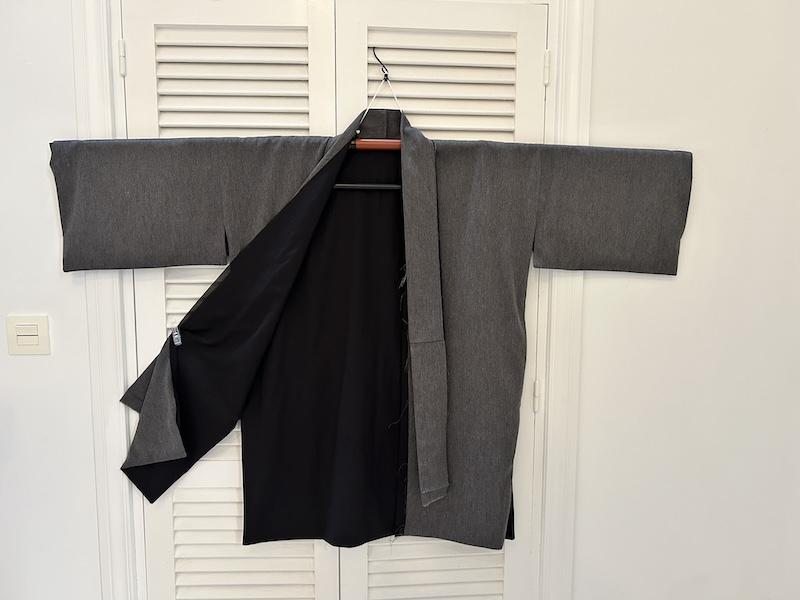
So, it’s almost done. The last and trickiest thing is left to do - sew on the collar, which needs to be done by hand.
I’m still not sure about the seam pockets. They went in easily, but they’re fucking with the line of the garment. If you look closely at the side seam, it’s sagging a bit. Probably not going to be obvious when it’s worn, but still. I’m wondering if it would be better to pull them out and make front patch pockets instead. What do you think?
#Sewing -
So, it’s almost done. The last and trickiest thing is left to do - sew on the collar, which needs to be done by hand.
I’m still not sure about the seam pockets. They went in easily, but they’re fucking with the line of the garment. If you look closely at the side seam, it’s sagging a bit. Probably not going to be obvious when it’s worn, but still. I’m wondering if it would be better to pull them out and make front patch pockets instead. What do you think?
#SewingIn the continuing saga of the side seam pockets, I removed them. And as you can see, the line is back to pretty close to perfection. There’s still a bit of bagging on the sides, where the pockets used to be, but I’m pretty sure that’s from fabric stretching and it will wash back to flat. #Sewing #Haori
-
In the continuing saga of the side seam pockets, I removed them. And as you can see, the line is back to pretty close to perfection. There’s still a bit of bagging on the sides, where the pockets used to be, but I’m pretty sure that’s from fabric stretching and it will wash back to flat. #Sewing #Haori
Now… shall we have patch pockets on the outside, or make useful ones on the inside? A coat without pockets seems a rather silly thing to me.
I do like the way the pockets break up the expanse of fabric. Hmm. What do we think?
-
Alrightee. That was a bit of a slog, but here we are - a haori coat with side slits and patch pockets. For those of you who know about Japanese garments, you’ll be aware of the dramatically long collar’s friend is not at all traditional, nor is the collar that stops before the hem, in the echo of a kimono collar. It’s eccentric but in a very quiet way. I’m rather proud of it. #sewing
-
Alrightee. That was a bit of a slog, but here we are - a haori coat with side slits and patch pockets. For those of you who know about Japanese garments, you’ll be aware of the dramatically long collar’s friend is not at all traditional, nor is the collar that stops before the hem, in the echo of a kimono collar. It’s eccentric but in a very quiet way. I’m rather proud of it. #sewing
Meanwhile, look what I scored: two old vintage tanmono (fabric bolts specifically for making kimono).
Both are pure silk. One is 12 meters and the other 22 meters. 26 and 27 Euros respectively. (for each entire bolt)
I don’t know what the import duties are going to run me, but if it’s feasible, I’m going to seriously consider starting a business. #sewing
-
Meanwhile, look what I scored: two old vintage tanmono (fabric bolts specifically for making kimono).
Both are pure silk. One is 12 meters and the other 22 meters. 26 and 27 Euros respectively. (for each entire bolt)
I don’t know what the import duties are going to run me, but if it’s feasible, I’m going to seriously consider starting a business. #sewing
It’s going to be a learning curve to figure out what to do with these. They’re both raw silk. They’re 60 years old.
Making stuff that requires dry cleaning seems fundamentally ecologically unethical to me, so I’m going to snag a little from each bolt and wash it in the machine and see what happens to it.
Garments should be wearable, and not require you to break the bank or ruin the planet to get it clean. #sewing
-
It’s going to be a learning curve to figure out what to do with these. They’re both raw silk. They’re 60 years old.
Making stuff that requires dry cleaning seems fundamentally ecologically unethical to me, so I’m going to snag a little from each bolt and wash it in the machine and see what happens to it.
Garments should be wearable, and not require you to break the bank or ruin the planet to get it clean. #sewing
@Remittancegirl At the risk of opening a bottomless rabbit hole, what did we do to wash silk before dry-cleaning? I’m guessing we had several thousand years of silk clothes before this was an option.
-
@Remittancegirl At the risk of opening a bottomless rabbit hole, what did we do to wash silk before dry-cleaning? I’m guessing we had several thousand years of silk clothes before this was an option.
@erik I don’t know what they did in Europe. In Japan they would completely unpick the kimono, sew it back into a full bolt, with the bits stitched together with whip stitches and join it in a giant belt, and they had a mechanical machine like a spinner that ran a single layer over a huge vat of steaming water. It took about 3 hours of the belt of silk rotating over the vat to get it clean. Then someone would dry it indoors, and sew the kimono back together.
-
@Remittancegirl At the risk of opening a bottomless rabbit hole, what did we do to wash silk before dry-cleaning? I’m guessing we had several thousand years of silk clothes before this was an option.
This post is deleted! -
This post is deleted!
This post is deleted! -
@erik I don’t know what they did in Europe. In Japan they would completely unpick the kimono, sew it back into a full bolt, with the bits stitched together with whip stitches and join it in a giant belt, and they had a mechanical machine like a spinner that ran a single layer over a huge vat of steaming water. It took about 3 hours of the belt of silk rotating over the vat to get it clean. Then someone would dry it indoors, and sew the kimono back together.
This post is deleted! -
This post is deleted!
@valhalla But also, kimonos all have what is called a tomo eri : ‘a collar’s friend’. It is sewn on top of the collar of the kimono, and can be removed once it is too worn or soiled, to reveal a pristine new collar! Because the neck is where the garment would normally get the most contact with the neck. @erik
-
@valhalla But also, kimonos all have what is called a tomo eri : ‘a collar’s friend’. It is sewn on top of the collar of the kimono, and can be removed once it is too worn or soiled, to reveal a pristine new collar! Because the neck is where the garment would normally get the most contact with the neck. @erik
This post is deleted! -
So, it’s almost done. The last and trickiest thing is left to do - sew on the collar, which needs to be done by hand.
I’m still not sure about the seam pockets. They went in easily, but they’re fucking with the line of the garment. If you look closely at the side seam, it’s sagging a bit. Probably not going to be obvious when it’s worn, but still. I’m wondering if it would be better to pull them out and make front patch pockets instead. What do you think?
#Sewing@Remittancegirl
This is not Japanese but a similar pattern. It is needlecord over-printed on, what looks like, a cushion design, some of which shows through.
It's a very useful jacket -
@Remittancegirl
This is not Japanese but a similar pattern. It is needlecord over-printed on, what looks like, a cushion design, some of which shows through.
It's a very useful jacket@HeatherMJ BTW, I really love the way the sides and hem are finished off!
-
@HeatherMJ BTW, I really love the way the sides and hem are finished off!
@Remittancegirl
The pattern suggested three different ways of finishing the seams. I'd never heard of a Hong Kong finish before, but I'm really pleased I chose it -
@Remittancegirl
The pattern suggested three different ways of finishing the seams. I'd never heard of a Hong Kong finish before, but I'm really pleased I chose it@HeatherMJ Is that using bias binding on the raw edges?
-
@HeatherMJ Is that using bias binding on the raw edges?
@Remittancegirl
That's the one. It's a good finish. -
@Remittancegirl
That's the one. It's a good finish.This post is deleted!



Feed RSS
Gli ultimi otto messaggi ricevuti dalla Federazione
-
@stefano aaaand.. maybe you mean Sandra Milo? 🤔 Or Sandra Mondaini?
-
@stefano
So wait, wait.. you're not the Amministratore Delegato of the Impresa BSD.Cafe S.r.l.? 🤔 Is there someone else behind this project?
-
@stefano Well, I just assume how it is.. because there are no pictures in that book (at least not in this first lesson) so I think that's the reason - they would show Sandra if she would be simpatica 🙂
-
@stefano works OK here.. so I hope it stay that way.. isnt's Fastweb already merged with Vodafone?
-
Una "promessa" mancata?
A 18 mesi dell'approvazione mancano ancora due decreti attuativi, senza i quali la legge resta in parte lettera morta come le prescrizioni che ci fanno i medici di base.Dl liste d’attesa: “ancora nessun beneficio concreto per i cittadini” | Panorama della Sanità
https://panoramadellasanita.it/site/dl-liste-dattesa-ancora-nessun-beneficio-concreto-per-i-cittadini/
-
@gian_d_gian Non dovrebbe occuparsi di questo argomento 😆
-
Foto da Maurizio Delladio
-
@superenea
non solo la tecnologia elettronica, mai visto uno saltare di palo in frasca come questo!