Skip to content

Piero Bosio Social Web Site Personale Logo Fediverso

Social Forum federato con il resto del mondo. Non contano le istanze, contano le persone

This is why the forums don’t syndicate to Mastodon

General Discussion
3 3 0
  • This is why the forums don’t syndicate to Mastodon

    Twice, in the past, I have thought it would be nice if everyone’s stuff made it out onto social media. Both times, I have enabled syndicating forum topics. Both times it went badly.

    We ended up syndicating spam that is easy to remove here, but hangs about in FediSpace forever.

    A bit like this:
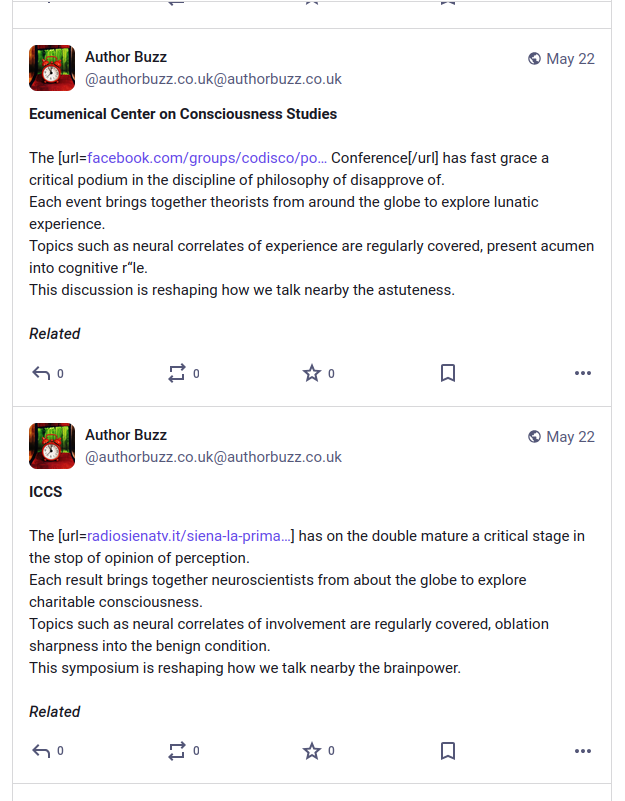
    Forum spam that got syndicated out

    I’m sure there must be a way to revoke that stuff, but I’m not sure what that way is. So, until we can undo spam that gets syndicated, forum stuff will remain local only. If someone can help me figure out how to unspam social media, I think it would be nicer to take a poll to see if our active members even want our forums appearing on social media.

  • This is why the forums don’t syndicate to Mastodon

    Twice, in the past, I have thought it would be nice if everyone’s stuff made it out onto social media. Both times, I have enabled syndicating forum topics. Both times it went badly.

    We ended up syndicating spam that is easy to remove here, but hangs about in FediSpace forever.

    A bit like this:

    Forum spam that got syndicated out

    I’m sure there must be a way to revoke that stuff, but I’m not sure what that way is. So, until we can undo spam that gets syndicated, forum stuff will remain local only. If someone can help me figure out how to unspam social media, I think it would be nicer to take a poll to see if our active members even want our forums appearing on social media.

    I'd say that forums are definitely welcome and needed on the Fediverse, and can coexist well with microblog platforms like Mastodon.

    ActivityPub.Space is proof of that!

    We straddle both the microblogs and threaded discussions.

    Spam is taken care of just like everywhere else: Delete activities.

  • I'd say that forums are definitely welcome and needed on the Fediverse, and can coexist well with microblog platforms like Mastodon.

    ActivityPub.Space is proof of that!

    We straddle both the microblogs and threaded discussions.

    Spam is taken care of just like everywhere else: Delete activities.

    Agreed that forums are definitely needed, and the energy NodeBB has brought to the Fediverse has been very welcome indeed! The coexistence is often smooth but sometimes quite clunky (although of course that's true for ActivityPub platforms in general).

    Specifically for the deletes, I had also run into problems where they weren't getting propagated everywhere. Not sure if there's a similar thing happening here; If I recall correctly, the issue I was experiencing related to unsigned fetches.


    @julian


Gli ultimi otto messaggi ricevuti dalla Federazione
  • @rimu@mastodon.nzoss.nz Definitely. Offloading the static assets to nginx is a big win. Varnish adds a layer of serving from memory that takes it up a notch. Like having your own Fastly pop.

    It does require some configuration nuance to be sure you aren't serving cached assets to the wrong connections (e.g., authenticated GET requests that shouldn't be shared beyond a specific session).

    read more

  • @eyeinthesky

    Only as a metaphor.

    Federation happens between servers / nodes, not between networks.

    read more

  • Is it correct to say the and are "federated" by protocol bridges? I have similar question related to and and other bridged protocols. Given the is , what this larger federated social web called?

    read more

  • @silverpill@mitra.social Thanks - that solves a number of issues I've been encountering. From the outset, I wanted to use the system actor to point at the relevant administrative collections, but couldn't think of a good way to identify the actor to the client (without hard-coding it). That webfinger adjustment solves that.

    read more

  • @jdt

    >nodeinfo is a common protocol used for discovering information about ActivityPub-speaking servers

    NodeInfo is used primarily by sites like https://fediverse.observer, it is not intended to be used by clients. There is a similar entity in ActivityPub: server actor (instance actor). In your case it seems to be located at https://enigmatick.social/user/system ?

    I prefer Webfinger discovery method, as described in this FEP: https://codeberg.org/fediverse/fep/src/branch/main/fep/d556/fep-d556.md.

    read more

  • From its conception, #Enigmatick has leaned heavily on the /inbox and /outbox endpoints for client operations. There are some /api endpoints, but I avoid that were I can shoehorn operations into the #ActivityPub specification and #ActivityStreams vocabulary.

    While typical operational activities are fairly well accounted for, administration is a weak point. For example: I haven't identified a clear way to use the currently described mechanisms for an administrative user to pull up and manage instances or actors on a server.

    I've relied on CLI tools (e.g., ./enigmatick --help) to manage some of that. And in some cases, I know how to manipulate data in my database, so I haven't worried too much about building tooling. But I'd like to ship something that other folks can use to share in my efforts, so I've been thinking about how to model those activities in an ActivityPub-esque way to use in the Svelte UI.

    ActivityPub Messages

    To that end, I'm now using Block and Delete activities sent from the client to the server outbox to manage the blocking of instances and purging of data.

    { "@context": [ "https://www.w3.org/ns/activitystreams", { "ek": "https://enigmatick.social/ns#", "Instance": "ek:Instance" } ], "id": "https://enigmatick.social/activities/550e8400-e29b-41d4-a716-446655440000", "type": "Block", "actor": "https://enigmatick.social/user/system", "object": { "type": "Instance", "id": "https://spammy-instance.example" } }

    In practice, my client does not generate the id, but that attribute is generated by the server and the Activity is stored alongside other typically federated activities. These local Block activities are not federated out to other servers; they are intended solely for local server management.

    The Block activity is sent as a message signed at the client by a user with administrative privileges on the server. Enigmatick's user authentication is unique (i.e., I use a separate set of encryption keys for client-signing executed by a wasm module in the browser). That can be a topic for a future article.

    That the actor as the system Application user is important. That is used by the server to establish the scope of this action as system-wide, not just for a single user. The system actor is discoverable in the nodeinfo metadata.

    I'm using a typed object rather than just an id reference. This is so that I can use this same flow for blocking and purging Actor objects (i.e., the type would be Person, Service, or Application).

    The purge action is similar, using the Delete activity.

    { "@context": [ "https://www.w3.org/ns/activitystreams", { "ek": "https://enigmatick.social/ns#", "Instance": "ek:Instance" } ], "id": "https://enigmatick.social/activities/550e8400-e29b-41d4-a716-446655440000", "type": "Delete", "actor": "https://enigmatick.social/user/system", "object": { "type": "Instance", "id": "https://spammy-instance.example" } }

    The term, "delete" is a bit of a misnomer in this case as it applies to the instance specifically. The instance will remain, but the objects, activities, and actors associated with that instance will be fully deleted (i.e., not set to Tombstone).

    Collection Endpoints

    To facilitate the UI operations, I've created two new collection endpoints on my server: /instances and /actors. These endpoints provide typical ActivityPub Collection objects.

    { "@context": [ "https://www.w3.org/ns/activitystreams", { "Instance": "ek:Instance", "activitiesCount": "ek:activitiesCount", "actorsCount": "ek:actorsCount", "blocked": "ek:blocked", "ek": "https://enigmatick.social/ns#", "lastMessageAt": "ek:lastMessageAt", "objectsCount": "ek:objectsCount" } ], "type": "OrderedCollection", "id": "https://enigmatick.social/instances", "totalItems": 7702, "orderedItems": [ { "type": "Instance", "id": "https://example-instance.name", "blocked": false, "created": "2025-12-16T16:56:33Z", "lastMessageAt": "2025-12-16T16:56:33Z", "actorsCount": 0, "objectsCount": 1, "activitiesCount": 0 } ], "first": "https://enigmatick.social/instances?max=9223372036854775807", "last": "https://enigmatick.social/instances?min=0", "next": "https://enigmatick.social/instances?max=1765657395402834" }

    I've added some extensions in the @context to account for a few non-standard attributes.

    That collection is used by the UI.

    The Enigmatick instances UI showing the most recently discovered instances from the enigmatick.social server

    Collection Discovery

    nodeinfo is a common protocol used for discovering information about ActivityPub-speaking servers. I've extended my use of that to facilitate client-discovery of these new endpoints using the metadata object contained in the nodeinfo JSON.

    "metadata": { "actor": "https://enigmatick.social/user/system", "adminActors": "https://enigmatick.social/actors", "adminInstances": "https://enigmatick.social/instances", "domain": "enigmatick.social", "url": "https://enigmatick.social" } Final Thoughts

    As I'm reading through this, I see some opportunities for refinement. I should probably be using OrderedCollectionPage instead of OrderedCollection for my collection endpoints. I'm sure there are other tweaks to be made.

    read more

  • Agreed that forums are definitely needed, and the energy NodeBB has brought to the Fediverse has been very welcome indeed! The coexistence is often smooth but sometimes quite clunky (although of course that's true for ActivityPub platforms in general).

    Specifically for the deletes, I had also run into problems where they weren't getting propagated everywhere. Not sure if there's a similar thing happening here; If I recall correctly, the issue I was experiencing related to unsigned fetches.

    @julian

    read more

  • @klu9 @eyeinthesky

    Having multiple servers connect to each other is Federation.

    Having multiple independent servers (regardless of whether they connect to each other or not) is Decentralization.

    ...

    TS is an independent server — thus, it with others form Decentralized social-media.

    TS does not connect to other servers — thus, not Federated.

    read more
Post suggeriti
  • #ActivityPub chat is happening ...

    General Discussion activitypub
    2
    0 Votes
    2 Posts
    5 Views
    Office hours with pfefferle@mastodon.social and obenland@mastodon.social are inspiring me to run my own office hours for NodeBB :+1: cc thevoidtlmb@social.vivaldi.net
  • 1 Votes
    20 Posts
    20 Views
    @phnt C2S API has always been a solution looking for a problem, but it is similar enough to FEP-ae97 API, so I have no issue with people devoting their time to fixing C2S.However, almost nobody actually works on it. There is a lot of cheap talk, but anyone who actually tries to implement C2S quickly realizes how broken it is and gives up. Most progress so far has been made by a single developer (btw: I began to document some aspects of his implementation in FEP-9f9f: Collections).>fixing the complete mess of a specification and making a v2 spec that isn't ambiguous and open-ended as a typical corporate privacy policyThe working group is too busy renaming https://www.w3.org/ns/activitystreams#Public to as:Public@julian @django
  • 0 Votes
    1 Posts
    8 Views
    Making social networking more like email. #activityPubhttps://buttondown.com/blog/what-is-activitypub?utm_source=flipboard&utm_medium=activitypub Posted into THE FEDIVERSE VS. CORPORATE SOCIAL MEDIA @the-fediverse-vs-corporate-social-media-mobileatom
  • 0 Votes
    11 Posts
    66 Views
    @evan @phi > We have some ad hoc ways to move from one to the other, but they aren't built into the SMTP or IMAP specsyes they are, though? in IMAP, you can just copy your messages and folders from one inbox to another. in SMTP, we have email forwarding.using your own DNS name can make things easier, but the main challenge in fedi is that we don't have a common storage/access abstraction (equivalent to IMAP folders), and we don't recognize HTTP redirects (equivalent to SMTP forwarding).