November 9, 2015:
Retro gaming hits me in a way that has nothing to do with reliving childhood. I’m not chasing some warm glow from the past. I’m chasing everything I never touched because I didn’t have the hardware, the money, or the awareness.
When I find something new from twenty years ago, it instantly becomes part of my history. It retroactively inserts itself into my timeline like it was always waiting for me. That’s the thrill. That’s the hook.
Most people talk about retro like it’s a museum or a comfort blanket. For me it’s a hunt. It’s low-spec oddities, tiny experiments, strange ports, and half-forgotten PC releases I never even knew existed when they were new.
I like the feeling of walking into my own backlog and discovering something that should have been a classic in my personal canon long before I ever played it. There’s no curated nostalgia. No checklist. No preloaded significance. I build the meaning myself.
Enemy Mind ties straight into that pattern. Gurumin does too. They lead directly into the reviews that follow.
Enemy Mind
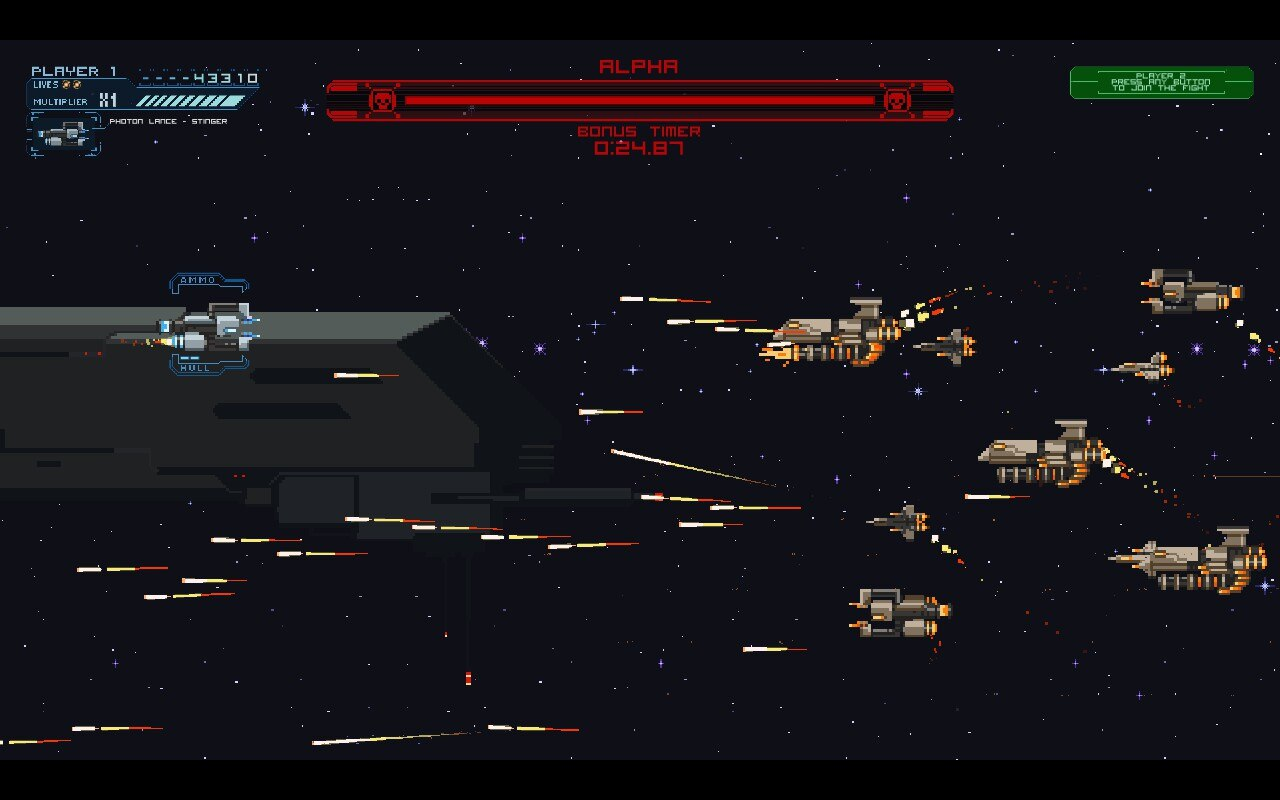
Enemy Mind deserved a wider audience. I say that without hesitation. A tiny shoot-’em-up from Schell Games that slipped through 2014 like it was wearing stealth gear. I didn’t buy it either. It showed up in a giveaway, and I installed it because I install everything. No expectations. No hype. Just another pixel shooter to kill a bus-stop wait.
Then I actually played it.
I remember standing there at night in the cold, HP Stream in hand, running Windows on a machine that should not have been able to run anything more demanding than Notepad. Enemy Mind didn’t care. It booted. It ran. I went to town.
The pixel art stamped itself into my visual cortex. The soundtrack welded itself to my memory. And because I was young and stupid enough to bring a laptop everywhere, I also played this at a cyber cafe after karaoke nights while inhaling instant noodles. The whole thing formed a vibe that I can’t untangle. Enemy Mind became a sensory bookmark for an era.
The premise hits fast. You don’t pilot a ship. You hijack them. You hop into whatever hostile craft you want and turn their own firepower against them. Twenty-plus ships, each with its own gimmick, ammo limits, firing arcs, and ways to get you killed.
It forces you to think like a scavenger instead of a pilot. You’re not mastering one ship. You’re cycling through an entire ecosystem of disposable metal coffins. The game becomes a study in opportunism. That makes it more imaginative than most horizontal shmups released in the last decade.
The design thinking behind this was serious. The devs built an eight-level campaign with seventy-plus waves and a story that reacts to which ship you finish waves with. They had to redesign bosses so you couldn’t just possess them and steamroll the encounter. They even added support ships whose only job is to block you from mind-jacking the wrong target.
Ammo scarcity forces you to plan your next possession before your current hull runs dry. This is what happens when a jam-week prototype gets expanded by people who actually understand game feel.
There’s co-op for up to four local players. That feature alone deserved way more attention than it got.
The whole thing shipped on Steam in June 2014, with trading cards, achievements, and a chiptune soundtrack by Mike Traficante, who apparently decided to credit himself as Rainbow Kitten. (Different Rainbow Kitten. Not the band. No relation. Don’t confuse them unless you want emails.)
Reception? Steam users liked it. Critics barely noticed it. Metacritic hosts a single review, which is hilarious given how many identical shooters get endless coverage. But Enemy Mind stuck around with a small but dedicated group of people who realized this was one of the rare shmups that wasn’t trying to drown you in particle effects. It wanted to mess with your brain instead.
So yeah. This one always deserved more fanfare. It didn’t get it. Fine. I’m giving it its flowers now.
Gurumin: A Monstrous Journey
Parin carries the whole thing. A kid moves to a new town, gets socially marooned, and immediately decides that if reality won’t give her friends, she’ll just brute-force her own world full of monsters who all have better personalities than any actual neighbor. That is the engine of this game.
Falcom built their first fully 3D action RPG around a lonely child with a drill who refuses to let adulthood’s rules dictate her imagination. Good choice.
Falcom already sat in my brain because of Ys. I played the Master System version like every other kid who thought FM synth qualified as a personality trait. But Gurumin was the game that locked them in for me.
It’s compact, it’s charming, it’s full of color, and it refuses to apologize for being earnest. The whole design is Falcom trying something new. New tech. New camera. New animation pipelines. A full jump into 3D with tools they weren’t known for, and it still feels cleaner than half the action RPGs that launched a decade later.
Combat runs on a simple principle. Parin has a drill. The drill is life. It levels up if you play clean, and it powers down if you mess up. It’s the world’s most adorable performance-based salary review. Every hit you avoid is forward momentum. Every mistake is the universe docking your pay.
Toss in outfits with real mechanical use, headgear upgrades, elemental properties, and a difficulty ladder that goes from Beginner to Crazy, and you get a system that rewards precision without ever punishing curiosity.
And yes, the controls still feel right even now. Falcom’s animation and movement logic were dialed in enough that you can finish this on PSP, PC, Steam Deck, or whatever refurbished office PC you pulled off Craigslist.
The visuals hold too. They’re stylized, not modern, which means they aged like vintage plastic instead of melting under new lighting tech. The 3DS port tried to chase stereoscopic novelty, but the PC and PSP versions remain the cleanest way to see the world in motion.
Reception at the time sat in the “very good but not fashionable enough” zone. PSP critics gave it high 70s. Famitsu handed out a 31/40. Nobody hated it. Nobody knew what to do with it. A mid-2000s action RPG starring a little girl with an overclocked drill wasn’t going to dethrone Final Fantasy XII.
It also didn’t help that its platform footprint made it easy to miss. Japan got it on Windows. The West got PSP. China got the Tomahawk F1, which is a console half the gaming population assumes I just made up. Only when Mastiff dumped it on Steam and GOG in 2015 did most people even discover Falcom had made anything this strange.
The English dub still surprises people. This tiny, whimsical RPG got the kind of cast you’d expect from a major animated feature: Tara Strong, Steve Blum, Kim Mai Guest, Dee Bradley Baker, Quinton Flynn. Kris Zimmerman-Salter directed the whole thing. It’s a flex. It also gives the game a tone that feels bigger than its budget. Every monster sounds like they’re genuinely thrilled that a human child is destroying furniture in their world for fun.
Gurumin never reached the scale or brand power of Ys or Trails. It sits in that Falcom tier reserved for the games that quietly shaped the studio’s identity while never becoming the franchise mascot.
But it holds its ground. It’s tight. It’s joyful. It’s confident. And it gives you a story where a kid conquers loneliness not through grit or trauma but by inventing an entire parallel community and drilling her way through anything that threatens it.
It didn’t get the fame it deserved. It did get me. And that counts.
 undefined