Salta al contenuto

Piero Bosio Social Web Site Personale Logo Fediverso

Social Forum federato con il resto del mondo. Non contano le istanze, contano le persone
  • What the hell?

    Mondo revolut privacy databreach security
    1
    0 Votazioni
    1 Post
    0 Visualizzazioni
    jonah@mastodon.neat.computer
    What the hell? https://www.internationalcyberdigest.com/revolut-gave-away-customers-data/Even if it *was* a legit email, you just hand over the data like “k yeah give me 5 mins” if a government agency asks?This is what happens when we have a no-questions-asked “sure here’s all our customer’s data” culture. Unacceptable. #Revolut #Privacy #DataBreach #Security
  • 0 Votazioni
    1 Post
    0 Visualizzazioni
    pitrh@mastodon.social
    There will be a PF tutorial at EuroBSDCon 2026 in Brussels:Network Management with the PF Packet Filter Toolset on OpenBSD and FreeBSDFeaturing Tom Smyth and Peter Hansteen, 2026-09-11, 10:30, full daySee https://events.eurobsdcon.org/2026/talk/RKCHRW/To register: https://tickets.eurobsdcon.org/eurobsdcon/brussels/#eurobsdcon #bsd #openbsd #freebsd #networking #firewall #security
  • 0 Votazioni
    3 Post
    16 Visualizzazioni
    alice_pea_3526@mastodon.social
    @Some_Emo_Chick Can we do this in New Zealand also!
  • 0 Votazioni
    1 Post
    0 Visualizzazioni
    dkade@mastodon.bsd.cafe
    And now something different, recovering and "old" laptop. https://dkade.com/posts/lenovo_t540p_bios_unlock/#hacking #electronics #security
  • BotKit security updates: 0.4.6 and 0.5.2

    Mondo security
    1
    0 Votazioni
    1 Post
    0 Visualizzazioni
    botkit@hackers.pub
    If you use BotKit, update to a patched release now. Two vulnerabilities affect Fedify versions included by BotKit as a dependency: CVE-2026-77632, a high-severity server-side request forgery vulnerability in the authenticated document loader, and CVE-2026-69132, a medium-severity denial-of-service vulnerability in the outbound delivery circuit breaker. CVE-2026-77632 affects the authenticated document loader Fedify uses to fetch remote documents such as actors and public keys with signed HTTP requests. Affected versions checked that the initial URL was public, but did not apply the same check when the URL returned an HTTP redirect. An attacker who controlled the public URL could redirect the signed request to a loopback address, a link-local cloud metadata service, or an RFC 1918 host. In the ordinary inbox path, Fedify may fetch a signature's keyId before it can verify the signature, so a bogus signature is enough to reach this path. The demonstrated attack is blind SSRF: the internal response is consumed while resolving the remote document and is not automatically returned to the attacker. The fix validates every redirect target before it is fetched. The existing allowPrivateAddress option continues to permit private destinations when an application explicitly opts in, such as for a closed federation or test environment. CVE-2026-69132 affects the outbound delivery circuit breaker introduced in Fedify 2.3, which records delivery failures in the configured key–value store using the remote inbox's host:port as part of the key. An attacker could send signed Follow activities from actors whose inbox URLs pointed to distinct ports where delivery would fail. Each failure created a separate record, allowing the attacker to grow circuit-breaker state until storage or memory was exhausted. Fedify 2.3.0 and 2.3.1 were vulnerable with every circuit-breaker configuration. In versions 2.3.2 through 2.3.4, the vulnerable configuration was a custom failure policy without an explicit stateTtl. The fix gives custom failure policies a bounded default stateTtl, equal to recoveryDelay plus heldActivityTtl (7 days 30 minutes with the default values). On stores that support compare-and-set operations, Fedify also sweeps circuit-breaker state left by affected releases and stamps it with a TTL. BotKit 0.4.x versions through 0.4.5 and BotKit 0.5.x versions through 0.5.1 include a Fedify version affected by CVE-2026-77632. The circuit-breaker issue, CVE-2026-69132, affects only the BotKit 0.5.x line. Patched releases are BotKit 0.4.6 and 0.5.2. BotKit 0.4.6 uses Fedify 2.1.21, and BotKit 0.5.2 uses Fedify 2.3.5. For BotKit 0.5.x, update @fedify/botkit: npm update @fedify/botkit yarn upgrade @fedify/botkit pnpm update @fedify/botkit bun update @fedify/botkit deno update @fedify/botkit For BotKit 0.4.x, update @fedify/botkit: npm update @fedify/botkit@0.4.6 yarn upgrade @fedify/botkit@0.4.6 pnpm update @fedify/botkit@0.4.6 bun update @fedify/botkit@0.4.6 deno update @fedify/botkit@0.4.6 After updating, redeploy. The GitHub Security Advisories are GHSA-cxc3-7q96-6cpx and GHSA-fx98-wc5v-jrg5. See also Fedify's own announcement. Thanks to Jace and @nyanrus for the reports and responsible disclosure. If anything is unclear, feel free to ask on GitHub Discussions or Matrix.
  • Fedify security updates: 2.0.26, 2.1.22, 2.2.11, and 2.3.6

    Mondo security
    1
    0 Votazioni
    1 Post
    0 Visualizzazioni
    fedify@hackers.pub
    If you use an affected Fedify release, update now. Two vulnerabilities have been fixed in @fedify/fedify: CVE-2026-77632, a high-severity server-side request forgery vulnerability in the authenticated document loader, and CVE-2026-69132, a medium-severity denial-of-service vulnerability in the outbound delivery circuit breaker. CVE-2026-77632 affects versions 1.6.1 through 2.3.4. Fedify uses an authenticated document loader when it fetches remote documents such as actors and public keys with a signed HTTP request. Affected versions checked that the initial URL was public, but did not apply the same check when that URL returned an HTTP redirect. An attacker who controlled the public URL could redirect the signed request to a loopback address, a link-local metadata service, or an RFC 1918 host. In the ordinary inbox path, Fedify may fetch a signature's keyId before it can verify the signature, so a bogus signature is enough to reach this path. The demonstrated attack is blind SSRF: the internal response is consumed while resolving the remote document and is not automatically returned to the attacker. The fix validates every redirect target before it is fetched. The existing allowPrivateAddress option still permits private destinations when an application explicitly opts in, such as for a closed federation or test environment. CVE-2026-69132 affects versions 2.3.0 through 2.3.4. Fedify 2.3 introduced an outbound delivery circuit breaker that records failures in the configured key–value store, using the remote inbox's host:port as part of the key. An attacker could send signed Follow activities from actors whose inbox URLs pointed to distinct ports where delivery would fail. Each failure created a separate record, allowing the attacker to grow circuit-breaker state until storage or memory was exhausted. Versions 2.3.0 and 2.3.1 were vulnerable with every circuit-breaker configuration. In versions 2.3.2 through 2.3.4, the vulnerable configuration was a custom failure policy without an explicit stateTtl. The fix gives custom failure policies a bounded default stateTtl, equal to recoveryDelay plus heldActivityTtl (7 days 30 minutes with the default values). On stores that support compare-and-set operations, Fedify also sweeps circuit-breaker state left by affected releases and stamps it with a TTL. Applications that need a different retention period for a custom failure policy can continue to set stateTtl explicitly. The SSRF fix first appeared in 2.0.25, 2.1.21, 2.2.10, and 2.3.5; the circuit-breaker fix first appeared in 2.3.5. The current releases on those lines are 2.0.26, 2.1.22, 2.2.11, and 2.3.6, and those are the versions we recommend installing. The circuit-breaker issue only affects the 2.3 line; the authenticated document-loader issue affects every Fedify release from 1.6.1 through 2.3.4. If you still use Fedify 1.x, change your dependency to a current 2.x release because package-manager update commands do not cross the declared major-version range. The GitHub Security Advisories are GHSA-cxc3-7q96-6cpx and GHSA-fx98-wc5v-jrg5. Update @fedify/fedify: npm update @fedify/fedify yarn upgrade @fedify/fedify pnpm update @fedify/fedify bun update @fedify/fedify deno update @fedify/fedify After updating, redeploy. If you run other Fedify-based servers, update those too. Thanks to Jace and @nyanrus for the reports and responsible disclosure. If anything is unclear, ask below.
  • 0 Votazioni
    1 Post
    0 Visualizzazioni
    mboelen@mastodon.social
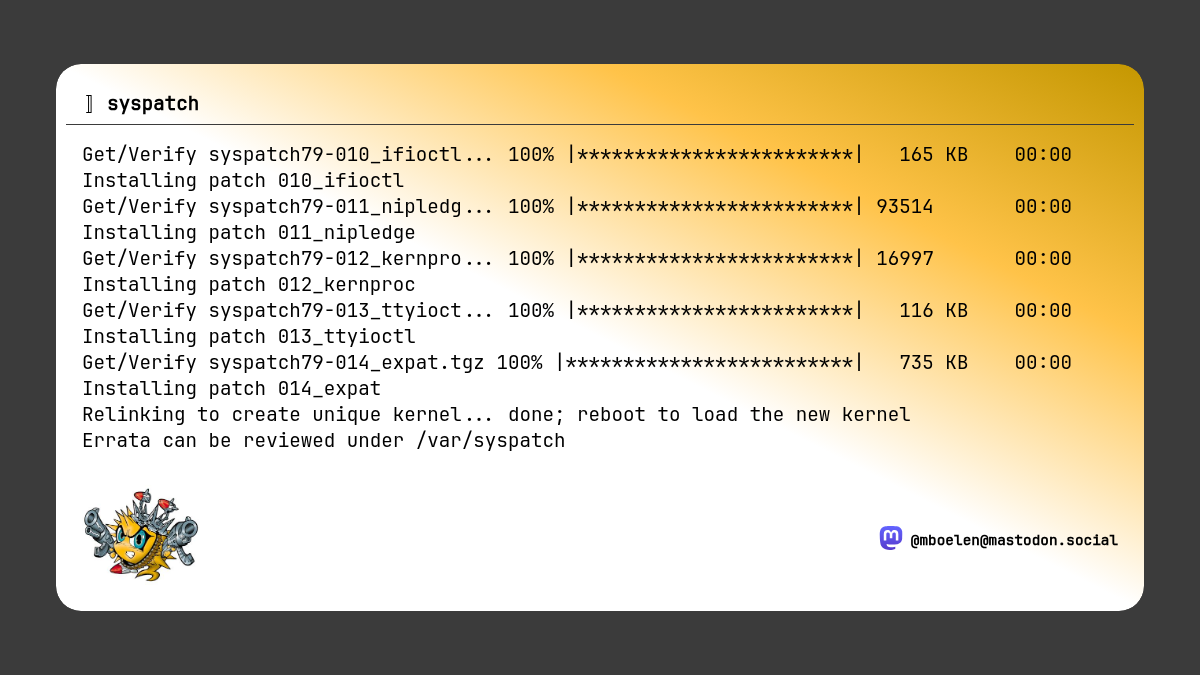
    I think #OpenBSD has one of the easiest methods to update (important) system updates. Just run syspatch and reboot.Simplicity has many benefits and I think OpenBSD is one that clearly shows this.#OpenBSD #systemadministration #security
  • OpenBSD 7.9 // IKED // ERRATA 009

    Mondo openbsd security update
    1
    0 Votazioni
    1 Post
    0 Visualizzazioni
    bsd@mastodon.bot
    OpenBSD 7.9 // IKED // ERRATA 009Date: August 11, 2026Name: 009_iked.patchDescription: iked(8) could be crashed remotely pre authentication. Link: https://cdn.openbsd.org/pub/OpenBSD/patches/7.9/common/009_iked.patch.sig#OpenBSD #Security #Update
  • GrapheneOS version 2026080500 released:

    Mondo grapheneos privacy security
    1
    0 Votazioni
    1 Post
    0 Visualizzazioni
    grapheneos@grapheneos.social
    GrapheneOS version 2026080500 released:https://grapheneos.org/releases#2026080500See the linked release notes for a summary of the improvements over the previous release.Forum discussion thread:https://discuss.grapheneos.org/d/40968-grapheneos-version-2026080500-released#GrapheneOS #privacy #security
  • 0 Votazioni
    1 Post
    0 Visualizzazioni
    grahamperrin@mastodon.bsd.cafe
    FreeBSD Security in Production: Vulnerability Response and Operational Best Practiceshttps://klarasystems.com/webinars/freebsd-security-production-vulnerability-response-best-practices/― join Klara’s Allan Jude and FreeBSD Security Officer Gordon Tetlow for a technical discussion on securing production FreeBSD systems. 2026-09-02 15:00 UTChttp://timee.io/e/freebsd-security-202609#FreeBSD #security #hardening #vulnerability @allanjude
  • 0 Votazioni
    40 Post
    0 Visualizzazioni
    gglockner@social.seattle.wa.us
    @newstik @fazalmajid @briankrebs Hopefully the dehumidifier doesn't send usage reports, unlike "smart" TVs.
  • BotKit security updates: 0.4.5 and 0.5.1

    Mondo botkit security
    1
    0 Votazioni
    1 Post
    0 Visualizzazioni
    botkit@hackers.pub
    If you use BotKit, update to a patched release now. CVE-2026-62857 affects Fedify's NodeInfo client, and BotKit includes the affected Fedify versions as a dependency. Fedify can look up a remote server's NodeInfo document to learn what software it runs. The lookup first fetches the server's /.well-known/nodeinfo document, then follows the NodeInfo document URL advertised in that response. The vulnerable paths are getNodeInfo() and the Context.lookupNodeInfo() method that wraps it: affected versions sent both requests without checking that their destinations were on the public internet. Because the second URL comes from the remote server's response, an attacker who controls a server being looked up could point it at a loopback address, a link-local cloud metadata endpoint, an RFC 1918 host, or a data: URL. Depending on the deployment environment and network routing, this could cause a BotKit application that looks up NodeInfo to fetch non-public network resources and return their contents to the application. The fix routes both requests through Fedify's public-address validation. It checks every request before sending it, including each redirect hop, limits the number of redirects, refuses redirects that cross protocols, and rejects non-HTTP(S) URLs. Servers are exposed only if they look up remote NodeInfo, but such lookups are commonly used for peer discovery and instance metadata. BotKit 0.4.x versions through 0.4.4 and BotKit 0.5.0 are affected. Patched releases are 0.4.5 and 0.5.1. BotKit 0.4.5 uses Fedify 2.1.19, and BotKit 0.5.1 uses Fedify 2.3.3. For BotKit 0.5.x, update @fedify/botkit: npm update @fedify/botkit yarn upgrade @fedify/botkit pnpm update @fedify/botkit bun update @fedify/botkit deno update @fedify/botkit For BotKit 0.4.x, update @fedify/botkit: npm update @fedify/botkit@0.4.5 yarn upgrade @fedify/botkit@0.4.5 pnpm update @fedify/botkit@0.4.5 bun update @fedify/botkit@0.4.5 deno update @fedify/botkit@0.4.5 After updating, redeploy. The GitHub Security Advisory is GHSA-hqph-j65v-8cq5, and the CVE ID is CVE-2026-62857. See also Fedify's own announcement. Thanks to @rvzsec and @manus-use for the report and responsible disclosure. If anything is unclear, feel free to ask on GitHub Discussions or Matrix.
  • 0 Votazioni
    1 Post
    0 Visualizzazioni
    fedify@hackers.pub
    If you use Fedify, update to a patched release now. CVE-2026-62857 affects Fedify's NodeInfo client. An attacker who runs any instance your server looks up could cause that server to fetch non-public network destinations and return their contents to your application, depending on the deployment environment and network routing. Fedify can look up a remote instance's NodeInfo document to learn what software it runs. The lookup happens in two steps: it fetches the instance's /.well-known/nodeinfo document, then follows the NodeInfo document URL that response advertises. The vulnerable path is getNodeInfo(), along with the Context.lookupNodeInfo() method that wraps it: affected versions sent both requests without validating the destination against public-network expectations. Because that second URL comes straight out of the remote server's response body, the instance being looked up fully controls it, and could point it at a loopback address, a link-local metadata endpoint, an RFC 1918 host, or a data: URL. Servers are exposed only if they look up NodeInfo, but that lookup is routine for peer discovery and instance metadata. The fix routes both requests through the same public-address validation Fedify already applied to WebFinger lookups and remote document loading. Every request is now checked before it is sent, including each redirect hop, so a public URL cannot bounce a request to an internal address. Redirects are followed with a cap and are refused if they cross protocols, and non-HTTP(S) URLs such as data: are rejected outright. These are patch releases, so they tighten behavior without adding new API. If you deliberately look up NodeInfo on a private or intranet address, such as in a closed federation or a test environment, these releases will now refuse it. An allowPrivateAddress opt-out is coming in 2.4.0. Current patched releases are 1.9.13, 1.10.12, 2.0.22, 2.1.18, 2.2.7, and 2.3.2. The GitHub Security Advisory is GHSA-hqph-j65v-8cq5, and the CVE ID is CVE-2026-62857. Update @fedify/fedify: npm update @fedify/fedify yarn upgrade @fedify/fedify pnpm update @fedify/fedify bun update @fedify/fedify deno update @fedify/fedify After updating, redeploy. If you run other Fedify-based servers, update those too. Thanks to @rvzsec and @manus-use for the report and responsible disclosure. If anything is unclear, ask below.

  • 0 Votazioni
    1 Post
    0 Visualizzazioni
    h4ckernews@mastodon.social
    Briar Is in Maintenance Modehttps://briarproject.org/news/2026-maintenance-mode/Comments: https://news.ycombinator.com/item?id=48919869#HackerNews #Briar #Maintenance #Mode #Technology #Privacy #Security #OpenSource
  • 0 Votazioni
    21 Post
    0 Visualizzazioni
    prometheus@pmth.us
    Apple Product Security has time to monitor Twitter for disclosure posts but not to send a status update to the person who found the bug. The incentive structure is working exactly as designed.
  • 0 Votazioni
    44 Post
    0 Visualizzazioni
    rrr@deds.social
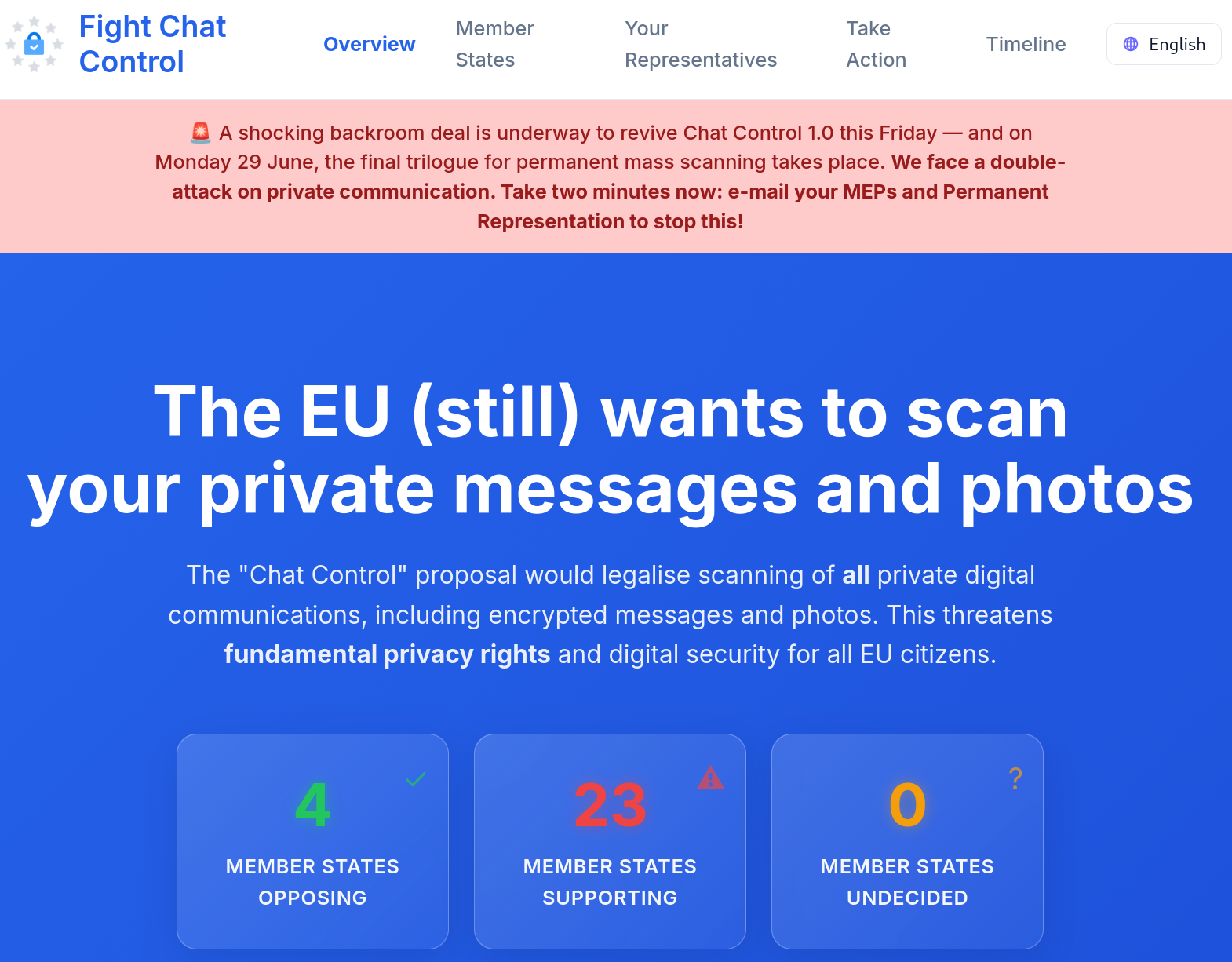
    @Tutanota I don't understand the 'score' for each European parliament member on the website https://fightchatcontrol.eu When I check the profile of a Dutch PvdA (thus S&D) representative it says 'supports'. The contrary of what one would expect. But in the details it says 'Chat Control 1.0 Extension - supports' and 'Chat Control 2.0 - Opposed'What is this about?
  • 0 Votazioni
    15 Post
    0 Visualizzazioni
    nonilex@masto.ai
    The election changes #Trump is seeking could be enormously #expensive for #states. For instance, the nationwide cost of upgrading #election equipment to align with voluntary voting standards has been estimated at $2.7 billion.In #Georgia, where the state legislature has also passed a #law to require hand-marked paper ballots, Republican Secy of State Raffensperger has estimated it will cost $66 million.#US #Constitution #VotingRights #TrumpCoup #midterms #BigLie #MafiaState #WhiteSupremacy
  • Today I released Lockpicker.

    Mondo gnome opensource security flathub
    1
    1
    0 Votazioni
    1 Post
    0 Visualizzazioni
    sstendahl@floss.social
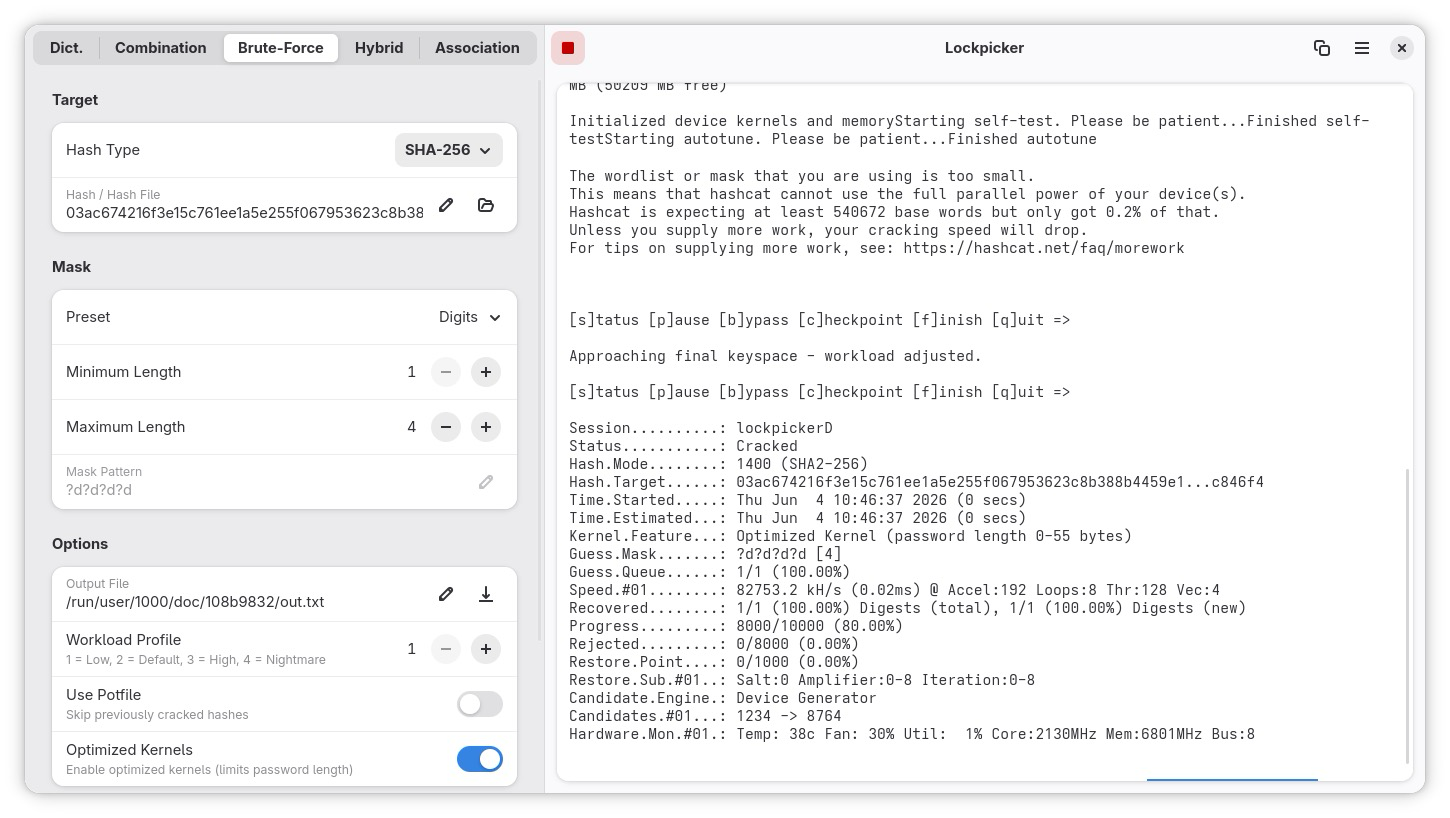
    Today I released Lockpicker. Lockpicker is essentially a GUI frontend to hashcat. Recover a password from its hash straight from a modern GNOME-native interface without the hassle of dealing with hashcat syntax.Early release. It still has a few rough edges UI-wise, where I probably want to do a pretty major overhaul eventually. I also need to redo the logo properly. But it works quite well, comes with OpenCI GPU acceleration. https://flathub.org/en/apps/se.sjoerd.lockpicker#GNOME #OpenSource #security #Flathub
  • 0 Votazioni
    1 Post
    0 Visualizzazioni
    riffraff@mastodon.social
    oh I got some really good scam attempt following the booking.com hack!I have an accommodation booked for this summer, and I received a message via whatsapp to update some details for the reservation.Not uncommon, but then they also asked for my CC, which they do not need since I’ll be paying through booking.So I got suspicious, called the hotel and they indeed denied any involvement.Be wary, just in case it happens to you too.#security #bookinghack